
THE LARGEST AIRPLANES TO HAVE EVER FLOWN
We’re not counting airships here… that’s unfair. Similarly, the ‘Wing-in-Ground-Effect’ Ekranoplans have their own, unique category. These are all true aeroplanes (what 'airplanes' are called here), the largest heavier-than-air behemoths in World history.
01. Antonov AN124 Ruslan
This giant was designed by the Soviet Union as a strategic airlift plane, back in the early 1980s. Its first flight was in 1986 and it’s still used today, although production stopped back in August 2014. It can carry 150 tons of cargo and is the largest military aircraft.

02. Corvair XC-99
Only one of these huge planes was ever built as a prototype, back in the 1940s. Based on the Convair B-36 Bomber, this plane was the biggest land-based transport aircraft with a piston-engine to have ever been built. It’s first and only flight was on the 24th November 1947 in California. It’s now in the National Museum of the United States Air Force in Dayton, Ohio.


03. Blohm & Voss BV238
Known as a “ (very large) flying boat” or a “flugboot”, this plane was the largest aircraft built by any of the German allies during World War II, but only one was ever completed. The prototype was destroyed, and further development scrapped, by the end of the war.


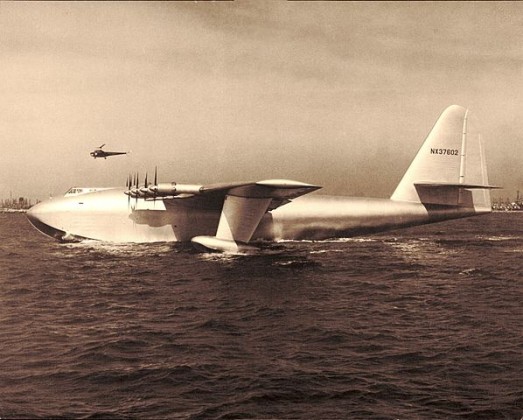
04. Hughes H4 Hercules "Spruce Goose"
The Hughes H-4 Hercules (also known as the "Spruce Goose") is a prototype strategic airlift flying boat designed and built by the Hughes Aircraft Company. Intended as a transatlantic flight transport for use during World War II, it was not completed in time to be used in the war. The aircraft made only one brief flight in 1947 and the project never advanced beyond the single example produced.Built from wood because of wartime restrictions on the use of aluminium and concerns about weight, it was nicknamed the "Spruce Goose", although it was made almost entirely of birch. The Hercules is the largest flying boat ever built and had the largest wingspan of any aircraft in history (321 ft or 98m) up until the "Stratolaunch" (see end). It remains in good condition and is on display at the Evergreen Aviation & Space Museum in McMinnville, Oregon, United States.

05. Antonov An-225 Mriya
The Antonov An-225 Mriya (Ukrainian: Антонов Ан-225 Мрія (Dream), NATO reporting name: "Cossack") is a strategic airlift cargo aircraft that was designed by the Soviet Union's Antonov Design Bureau in the 1980s. It is powered by six turbofan engines and is the longest and heaviest airplane ever built, with a maximum takeoff weight of 640 tonnes (710 short tons). It also has the largest wingspan of any aircraft in operational service.
The Antonov An-225, initially developed for the task of transporting the Buran spaceplane, was an enlargement of the successful Antonov An-124. The first and only An-225 was completed in 1988. The airlifter holds the absolute world records for an airlifted single item payload of 189,980 kilograms (418,834 pounds), and an airlifted total payload of 253,820 kg (559,577 lb).

The Antonov An-225, initially developed for the task of transporting the Buran spaceplane, was an enlargement of the successful Antonov An-124. The first and only An-225 was completed in 1988. The airlifter holds the absolute world records for an airlifted single item payload of 189,980 kilograms (418,834 pounds), and an airlifted total payload of 253,820 kg (559,577 lb).

06. Convair B-36 Peacemaker
Despite the name, this plane is a strategic bomber. Built in the 1940s, its first flight was on the 8th August 1946. 384 of these were produced between 1946 and 1954, making it also one of the most popular - and with nuclear armament capability - most deadly on the list.


07. Ilyushin II-76
The Soviets seem to have a bit of a knack when it comes to large aircraft, and this was one of their first jet cargo planes. No matter what the weather or terrain, this plane can do it all – making it one of the most versatile of all the aircraft on our list. It is still in production today. Pictured: the IL-76D water tanker.


08. Zeppelin-Staaken R.VI
We’re going all the way back to 1916 now, with one of the biggest aircraft during WW1 – at least one of the biggest to be regularly used. The Germans created this 138 ft (42m) wingspan wooden plane as a strategic bomber and 18 were built in total.

09. Boeing C-17 Globemaster III
The Globemaster III is used as a cargo plane, and can take off or land in practically any terrain. The United States Air Force are clearly big fans of their creation, having over 260 in active use in 2016. Wingspan is170 ft (51m) with an 80-ton equipment limit.


10. Lockheed Martin C-130J Super Hercules
Still in active use, the Lockheed Martin C-130J Super Hercules , is currently being used by air forces in over 14 countries. Able to fly slowly owing to the turboprops, the plane can be fitted as a water tanker for remote fire control. Known locally as a ‘Flossie’, the C130 and C160 troop transporters have rear-facing seats for safety.


11. Martin JRM Mars
The Martin JRM Mars is the largest of any of the flying boats in existence, and was built by the US. Only seven were built in total, between 1945 and 1948.


12. Junkers JU 390
As with many of the planes on this list, the Junker JU 390 was only ever really built as a prototype. The Germans designed and built this plane in order to use it as a heavy transport aircraft, and also as a long-range bomber. At the time, it was the largest aircraft to have ever been built – until the Blohm & Voss 238 had its maiden flight. It had a wingspan of just over 165 ft.


13. Lockheed C-5 Galaxy
This is one of the largest military planes in the world that’s still in use – and it’s one of the most modern on our list, despite hailing from the late 1960s. This transport aircraft is used primarily by the United States Air Force, although there are 131 in circulation around the world. Back in 1998 these cost a whopping $152.8 million to make, but the newest versions now cost less than $90 million.


14. Boeing B-29 Superfortress
This military aircraft was absolutely huge for its time and quickly became a popular plane during World War II and the Korean War. The plane, used mainly by the US, was extremely advanced for its time; having first been introduced in 1944. During a its 3 year production run nearly 4,000 were produced and used until its retirement in 1960. The Boeing B-29 Superfortress had a whopping wingspan of just over 141 ft.


15. Antonov An-22
This military transport aircraft was designed and built by the Russians back in 1966, and is still in active service today. The Antonov An-22 is powered by four turboprop engines, making it the largest turboprop aircraft to still be in use today. It’s thought that just under 70 of these were built between 1966 and 1976, although they’re currently being phased out by the An-124.


16. Boeing B-52 Stratofortress
Back to a more modern military aircraft now, and yet another to be designed and built for the US Air Force. This Boeing offering is nothing short of a giant, with a wingspan of 185 ft and a maximum take-off weight of 488,000lb. This strategic bomber was first produced in 1952, taking to the skies in April of the same year. Production was stopped 10 years later after around 750 were built, however it is still in active service today.


17. Kalinin K-7
This Russian flying fortress is another experimental aircraft to make it onto our list, designed and built in the early 1930s. The configuration of this military plane was quite unusual, thanks to the large pods under the wings to hold machine guns and landing gear. Its first flight was in 1933 and it showed some serious instability, which led to a few design changes and yet another test. Unfortunately, the plane crashed and burned and the project was abandoned.


18. Tupolev Tu-160
This aircraft entered IOC service back in 1987 and full service in 2005. Designed and built in the Soviet Union, the Tupolev Tu-160 is the largest aircraft in the world in terms of combat, supersonic, and variable sweep. Only a few military transporters or civil planes are actually larger than this strategic bomber. A modernization program has been underway since 2014 to update these huge planes.


19. Xian Y-20
This Chinese military transport plane was officially launched back in 2006, but didn’t take its first flight until 2013. It was officially introduced in December 2015, after years of testing and various prototypes. Known as ‘Chubby Girl’, this plane has 4 prototypes in service currently and more are being built as at March 2016.

20. North American XB-70 Valkyrie
The name of this plane may ring a bell, as Valkyrie is known in Norse mythology as ‘the chooser of the slain’. It was built to be armed with nuclear weapons and to reach such a speed that it would be practically immune to interceptors. Essentially, this was going to be one seriously deadly aircraft. The program was started in the early 1960s, cost $1.5 billion, and then was scrapped in 1969.


21. Airbus A380
For more, see the wikipedia page.
 |
| World's largest passenger jet as at 2017 |
22. Vulcan Aerospace Stratolaunch


The Stratolaunch vehicle was unveiled in 2017. The aircraft has 385-foot wingspan and, powered by six Pratt & Whitney engines (used on Boeing 747 aircraft) has a maximum takeoff weight of 1.3 million pounds. The Stratolaunch's wingspan is the largest in history, blowing away the previous record-holder (Howard Hughes' Spruce Goose) by 65 feet.
Vulcan Aerospace (established by Microsoft co-founder Paul Allen) says its Stratolaunch airplane will have an operational range of 2,000 nautical miles. Serving as a reusable first stage for rocket launches, the Stratolaunch system is capable of delivering payloads to multiple orbits and inclinations in a single mission.
Worth a mention...
The Tupolev ANT-20 Maxim Gorky (Russian: Туполев АНТ-20 "Максим Горький") was a Soviet eight-engine aircraft, the largest of the 1930s. Its wingspan was similar to that of a modern Boeing 747, and was not exceeded until the 211 ft (64.6m) wingspan of the American Douglas XB-19 heavy bomber prototype that first flew in the early summer of 1941.

Also worth a mention...
The Hybrid Air Vehicles HAV 304 Airlander 10 is the largest (lighter than air) aircraft in the sky today (2016/2017)
- Length: 91 m (298 ft 7 in)
- Width: 34 m (111 ft 7 in)
- Height: 26 m (85 ft 4 in)
- Envelope: 38,000 cubic metres
- Engines: four × 350 hp, 4 litre supercharged V8 diesel
 |
| It's really big! |


